
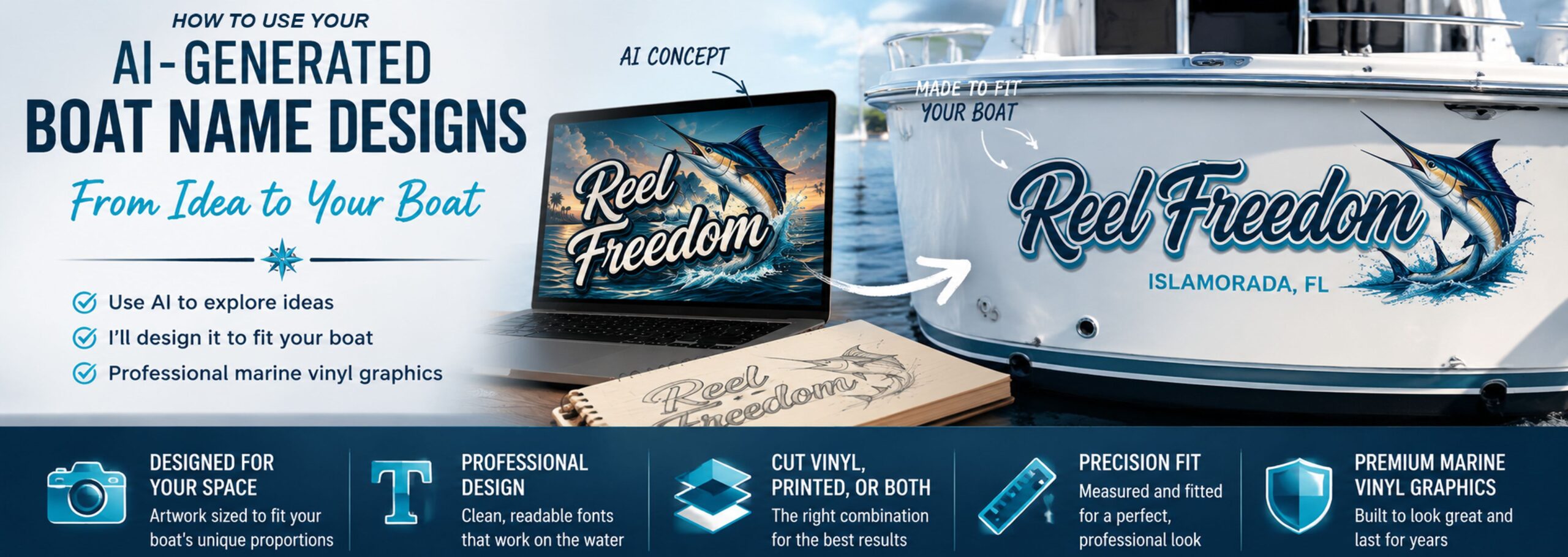
AI-Generated Boat Name Designs & Lettering
Our goal at Midnight Oil Workshop is always to implement our customer’s vision to the best of our ability. Traditionally, that meant starting with a conversation to give us a direction for the design process. And then to refine the artwork via email until our customer is satisfied with the results. Along the way I will consider the shape, contours, colors, available hull space and overall character of the boat when offering my design suggestions.
AI image generators have opened up a whole new way to brainstorm ideas for naming and lettering a boat. It can also be a very useful way to show me the general look you have in mind. Increasingly, customers come to me with an AI-generated boat name and say either, “This is what I want,” or “I like this idea—can you make something like it?”
In many cases, the answer is yes. But there is an important distinction between an AI-generated concept and production-ready artwork that can actually be manufactured with our in-house “blade-cut” vinyl and installed on a boat.
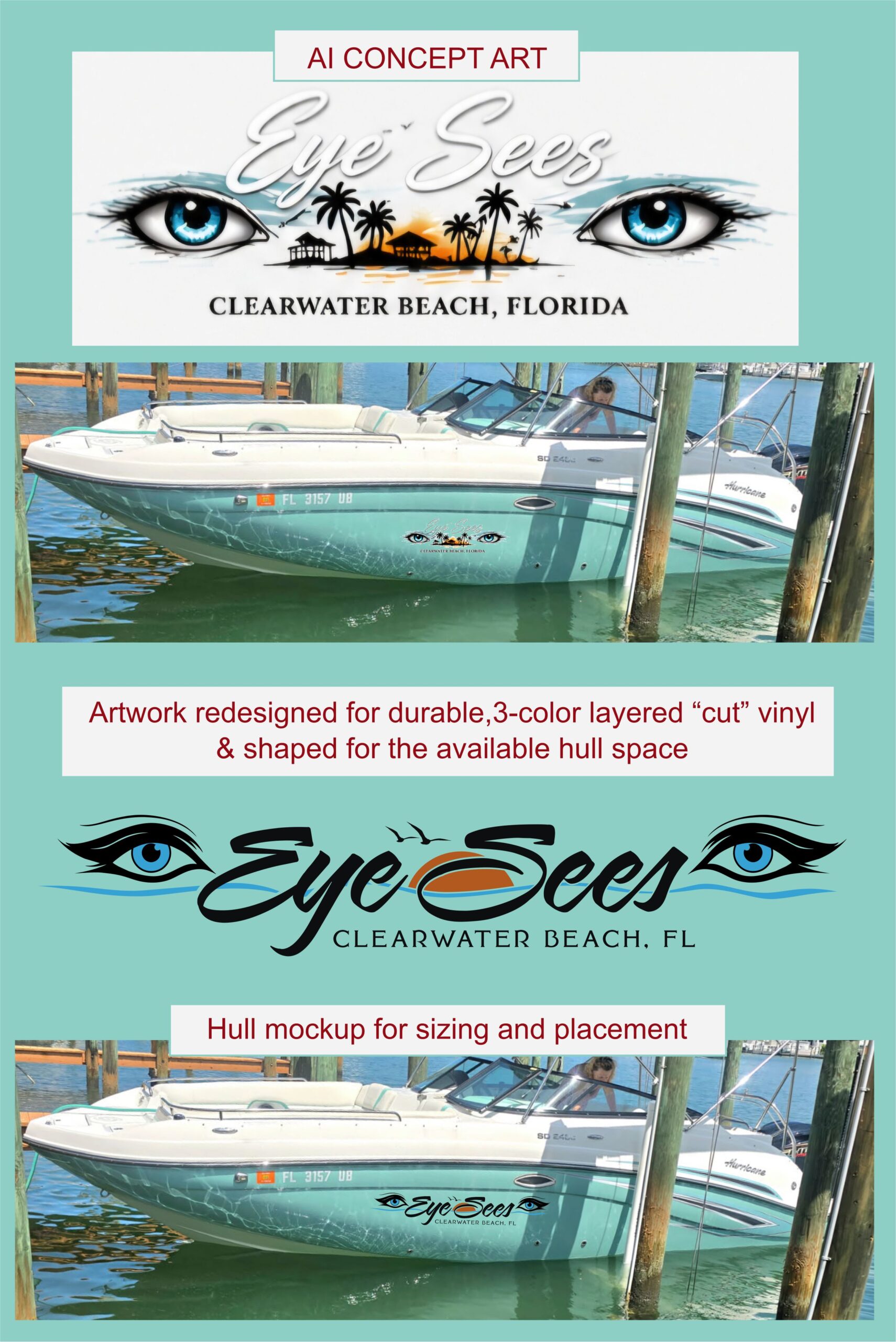
“Blade-Cut” vs “Inkjet Printed” lettering & graphics
When it comes to signs, most people think “printing” – where ink or paint is applied to a substrate to make the image. But the overwhelming majority of our boat names are created using a durable “blade-cut” vinyl film. Each vinyl color is cut separately from it’s own roll of colored vinyl and assembled in layers on your boat’s hull. With cut vinyl, the material is actually infused with a color at the factory, so there is no printing involved. This is the most durable option in a marine environment because the color goes all the way through the material – not just printed on the surface.
However, if your design requires complex colors, color blends or photo quality, it’s necessary to switch to an inkjet printed vinyl product (like a vehicle wrap). In this situation we will bypass our normal production process and outsource full color laminated prints to a commercial printer before installing it for you.
I should mention that inkjet printed vinyl is generally not as durable as our normal blade cut vinyl and can begin to fade in as few as 2-3 years in a marine environment – even with a UV resistant laminate. As a result, we do not guarantee the materials for inkjet printed vinyl as we do with our in-house blade cut process.
Do AI designs always need to be printed?
Not necessarily. If your AI design uses only solid colors we can “wireframe” your artwork to convert it into a “blade-cuttable” design. It all depends on how you specify your AI design prompt.
Below are some tips and tricks that can help you avoid some of the challenges and pitfalls when utilizing AI for your boat name design.
How to prompt your AI for blade cut vinyl
To prompt your AI for our in-house process always end your description with a command like the following:
Create the design using only solid, flat colors on a plain white background. Do not use gradients, shading, shadows, transparency, textures, photographic effects, or blended colors. Use clean, well-defined edges and clearly separated color areas so the artwork can be converted to vector paths and produced using cut vinyl on a sign-making vinyl cutter.
What if I prefer a full color printed boat name?
If you prefer a full color AI generated image, there are a few things to consider in order to get the results that you expect. Image resolution, design aspect ratio and background separation needs to be carefully selected for professional results. Also, it may be necessary for us to make a separate trip to your boat to collect measurements and order the prints.
Prompt for sufficient resolution
AI generated images are generated to look good on a computer screen, but they usually lack sufficient resolution for large format prints. An image that looks good on a computer or smartphone screen might look grainy and pixelated when blown up to the size of a boat transom. Increasing the size of an image is not the same as increasing pixel resolution. If you have your heart set on using your printed AI design, make sure it produces an original image with sufficient resolution for large format printing.
Typography and font selection
Another challenge to reproducing AI artwork is typography. AI image generators don’t necessarily select a conventional font when creating lettering. They may generate letterforms that resemble a particular style of type but don’t correspond to any commercially available font.
Background separation
Unless you are seeking a full printed boat wrap, you will want the white vinyl material to be trimmed around the artwork so that your hull shows through or around the image. That way it won’t look like a giant bumper sticker on your boat. If your design has drop shadows or colors that blend or dither into the background, you will see a distinct edge to the decal if the printed background of the design is not an precise match for your boat’s hull color. It’s especially relevant if your boat has a hull color other than white. If you decide that you need a full transom or boat wrap, we would point you to a vehicle wrap company that specializes in full vinyl wraps.
Designing for the Space Available on Your Boat
If you’re creating an AI boat-name design before contacting me, you can make the results much more useful by giving the AI some information about the space where the lettering will eventually go.
Take a reasonably straight-on photograph of the transom or hull area and estimate the usable width and height.
For example, if you have approximately 48 inches of width and 12 inches of height available, that’s roughly a 4:1 aspect ratio. Tell the AI that the entire boat-name composition needs to be very wide and relatively short, with approximately a 4:1 overall proportion.
You can also ask it to emphasize clear, readable lettering and avoid unnecessary backgrounds or decorative elements that make the design excessively tall or too busy to read at a distance.
Finally, instruct the AI to output a high resolution, production ready design file that you can share with your sign maker for viny lettering.
Cut Vinyl, Printed Graphics and a Combination of Both
If your AI-generated design includes gradients, photographic effects, complex shading or highly detailed illustrations. Those elements may require full-color printing rather than conventional cut vinyl. That doesn’t necessarily mean we have to abandon the more durable cut vinyl completely.
One solution I frequently use is a combination of cut vinyl lettering and printed graphics. For example, I might produce the boat name itself in cut marine vinyl and incorporate a full-color printed fish or other illustration into the finished design.
This often provides the best of both worlds: the clean appearance and flexibility of cut-vinyl lettering combined with full-color artwork where it adds something special to the design.
Inspiration or Exact Reproduction?
When you send me an AI-generated boat-name design, one of the most helpful things you can tell me is how closely you’re attached to the particular design.
There are essentially three possibilities:
“I like the general idea.”
Great. I’ll use the image to understand your preferences and develop a boat-lettering design that captures the spirit of it while working properly on your boat.
“I’d like it to look as much like this as reasonably possible.”
I’ll look for suitable fonts, colors and production techniques that get us close while allowing reasonable changes necessary for fabrication and fitting the boat.
“I want this exact design.”
I’ll evaluate the artwork to determine whether exact reproduction is practical. Depending upon the typography, resolution, graphics and production method, the artwork may need to be reconstructed or otherwise prepared for manufacturing.
Knowing which of these describes your expectations can save a great deal of design time and helps me recommend the best approach from the beginning.
AI Is Great for Ideas. My Job Is Making the Idea Work on Your Boat.
I enjoy seeing what customers come up with.
AI gives boat owners another creative tool for exploring the personality they want their boat name to have. Sometimes an AI concept leads directly toward the final design. Other times it simply starts a conversation that leads us somewhere completely different.
Either result is perfectly fine.
My job is to take the ideas you bring me—whether they’re an AI-generated image, a sketch on a piece of paper, a photograph of another boat, a favorite font, or simply a description of what you have in mind—and turn them into lettering that works on your particular boat.
So if you’ve already been experimenting with an AI-generated boat name, send it along. Tell me what you like about it, what you’re willing to change, and what you’d particularly like to preserve.
We’ll take it from there.

